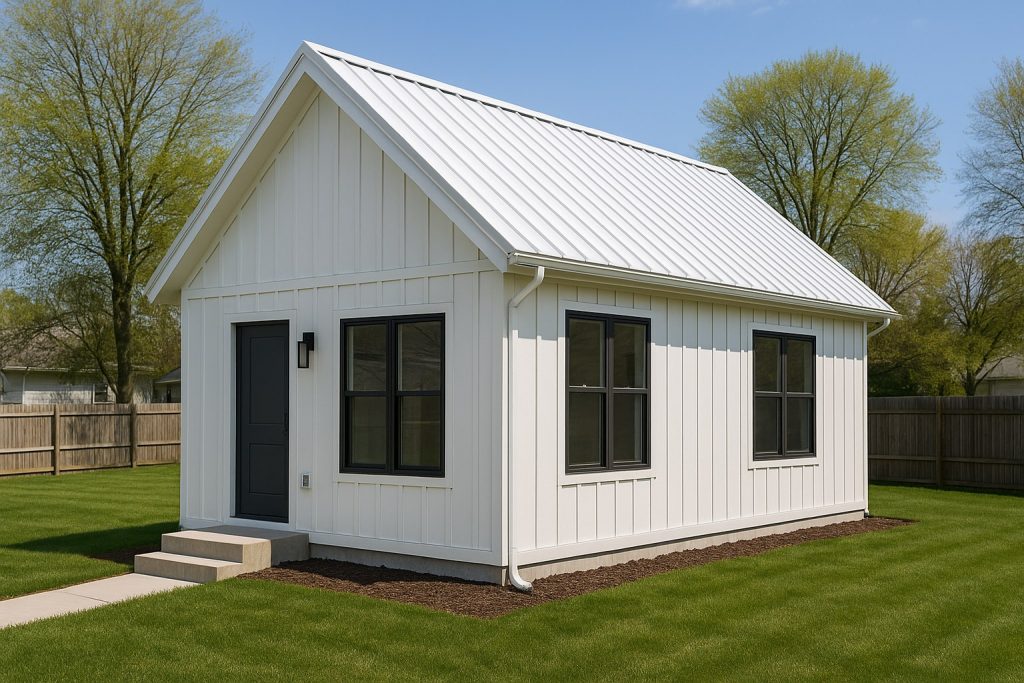
If you have extra room on your Iowa property, you may be weighing an ADU vs guest house as a way to add living space. The two sound similar, and people often use the terms interchangeably, but they are legally and practically different things. That difference changes what you can build, whether someone can truly live there full time, and how much value it adds to your property.
This head-to-head breaks down the ADU vs guest house question the way we walk homeowners through it, so you can match the right structure to your actual goal.
ADU vs guest house: the quick comparison
Here is how the two stack up on the factors that matter most.
| Factor | ADU | Guest House |
|---|---|---|
| Full kitchen | Yes, required | Usually no (or a kitchenette at most) |
| Independent living | Designed for it, full time | Short stays only |
| Legal rental | Yes, a permitted rentable unit | Generally not a legal rental |
| Own bathroom | Yes | Sometimes |
| Utilities | Full hookups, often metered | Often shares the main house |
| Adds appraised value | Strong, as a second dwelling | Modest, counted as an accessory structure |
| Permitting | Permitted dwelling unit | Accessory structure permit |
The kitchen is the dividing line
The single biggest difference in the ADU vs guest house comparison comes down to the kitchen. An accessory dwelling unit is a complete, self-contained home: full kitchen, bathroom, sleeping area, and its own entrance. A guest house, by contrast, is usually a bedroom-and-bath structure meant for weekend visitors, without a full cooking setup.
That may sound like a small detail, but it is what separates a place someone can genuinely live in from a place someone can only visit. If your goal is housing an aging parent, an adult child, or a long-term tenant, the guest house falls short precisely because it was never built to support daily life.
Independent living versus occasional stays
Think honestly about who will use the space and for how long.
- Choose an ADU if you want a relative to live near you with real independence, if you want rental income, or if you want a space that could adapt to different uses over the years.
- Choose a guest house if you only need somewhere for holiday visitors or the occasional out-of-town friend to sleep, and daily-living function does not matter.
Many Iowa families think they want a guest house, then realize what they actually need is independent living space for a parent or a returning college graduate. In those cases the ADU is the answer, because a guest room without a kitchen wears thin fast when someone stays for months instead of nights.
Rental income and property value
If money is part of your motivation, the two options are not close. A permitted ADU is a legal, rentable dwelling that can generate monthly income and is recognized by appraisers as a second living unit, which tends to add meaningful value to your property. A guest house is treated as an accessory structure and typically cannot be rented out as a separate residence, so its financial upside is limited.
Iowa’s rental market has stayed tight, and demand for smaller standalone homes remains strong. The U.S. Census Bureau tracks the steady growth in rental households nationwide, and a well-built ADU lets you tap that demand in a way a guest house simply cannot. If income or resale value is on your list, the ADU wins the ADU vs guest house decision decisively.
Cost expectations, set straight
Here is where we gently reset a common assumption. Roughly 7 out of 10 people we talk to expect a full living space can be built for under $50,000, largely because of TV shows and social media. A real, permitted ADU with a foundation, full utility hookups, code-compliant construction, and quality finishes costs considerably more than that.
A guest house without a kitchen or full utilities can cost less, which is part of its appeal. But you are paying less because you are getting less: no independent living, no legal rental, and far less added value. When you compare cost per usable purpose, the ADU usually delivers more for the money, especially if you plan to house family or earn rent. You can explore real sizes and layouts on our floor plans page, which run from a 475 sq ft Studio+ to an 816 sq ft two-bedroom.
Which is right for you?
Match the structure to the goal:
- Aging parents or multigenerational living want dignity and independence, which means an ADU with a real kitchen and bath.
- Rental income or added property value point to an ADU every time.
- Occasional overnight guests only, with no interest in renting or long stays, may be well served by a simpler guest house.
- Not sure yet? Lean ADU. It does everything a guest house does and far more, and it keeps your options open as your family’s needs change.
The honest takeaway on the ADU vs guest house question: a guest house is a nice-to-have for visitors, while an ADU is an investment in flexible, livable space. We handle design, permitting, financing guidance, and construction across the entire state of Iowa, so you do not have to untangle it alone. Book a free, no-pressure consultation and we will help you figure out which one truly fits your property and your plans.
Frequently asked questions
Can I convert a guest house into an ADU later?
Sometimes, yes, but it usually means adding a full kitchen, upgraded utilities, and meeting dwelling-unit code. It is often cheaper to build an ADU correctly from the start than to retrofit a guest house.
Does an ADU add more value than a guest house?
Generally yes. Appraisers recognize an ADU as a second dwelling unit, while a guest house counts as an accessory structure with more limited value.
Which one can I legally rent out in Iowa?
A permitted ADU can be rented as a separate residence. A guest house typically cannot serve as a standalone legal rental, so if income matters, the ADU is the right path.